Dara Flores Adventures · Destination Guide
Labuan Bajo
& Flores
A place with a story worth knowing
Most people arrive in Labuan Bajo with one thing in mind: the dragons. That is understandable. But the travellers who take a moment to understand where they actually are — what this small harbour town grew from and what surrounds it on land and at sea — leave with something different. Not just photographs. A sense of having been somewhere real.
This is that story.
The Harbour of the Bajo People
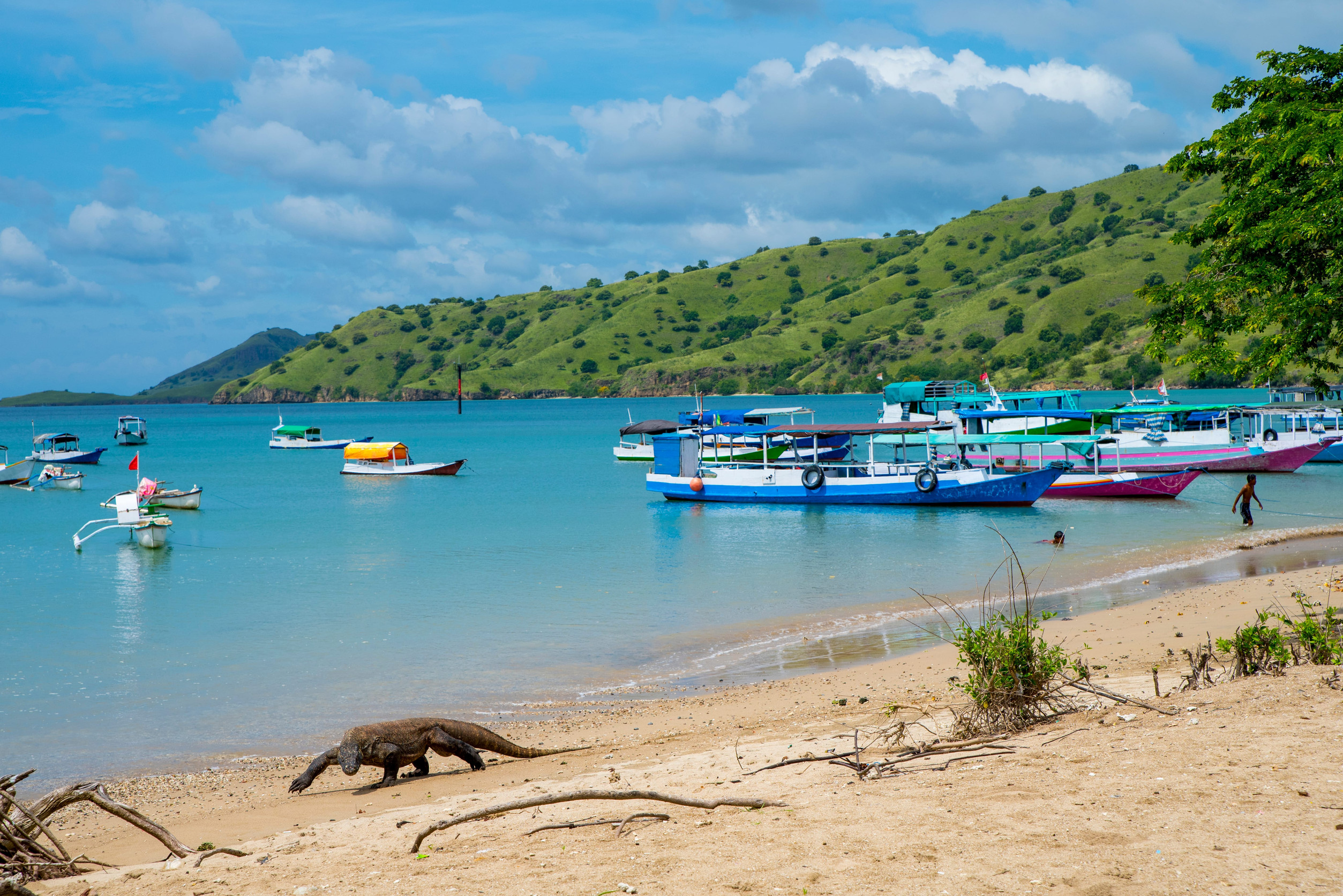
The name tells you almost everything. "Labuan" is an old Malay-Indonesian word for a natural anchorage, a harbour where boats find shelter. "Bajo" is the name of the people who first claimed this bay as their own.
The Bajo people were maritime nomads, often called sea gypsies, who migrated southward from Sulawesi and established coastal settlements along the western tip of Flores somewhere between the 15th and 19th centuries. They were accomplished open-ocean sailors who could read currents and weather in ways that took other mariners generations to learn. Their lives were built around the water. Originally a stopover for Bajo fishermen who lived on the move, Labuan Bajo served as a stopping point for traders passing through the Flores Sea. They did not have fixed homes in the land-bound sense. The boat was the home. The bay was the address.
The Manggarai people had long settled the deeper interior of Flores, farming the highlands while the Bajo held the coast. Between them, an organic trade relationship developed: Manggarai farmers would make the long journey down to the bay carrying rice, corn and potatoes, and exchange them for the fish and sea products the Bajo brought in. Two ways of living, one place. That dynamic — the sea meeting the land — is still the essential character of Labuan Bajo today.
By the 1950s, the Bajo people began settling permanently on shore, trading boat-based life for stilt houses and fixed communities along the coast. But their relationship with the sea never really ended. It simply changed form. The fishermen became boat captains. The sailors became guides. The knowledge of currents and tides that kept their ancestors alive in open water is the same knowledge that keeps a Phinisi on course through the straits of Komodo National Park today.
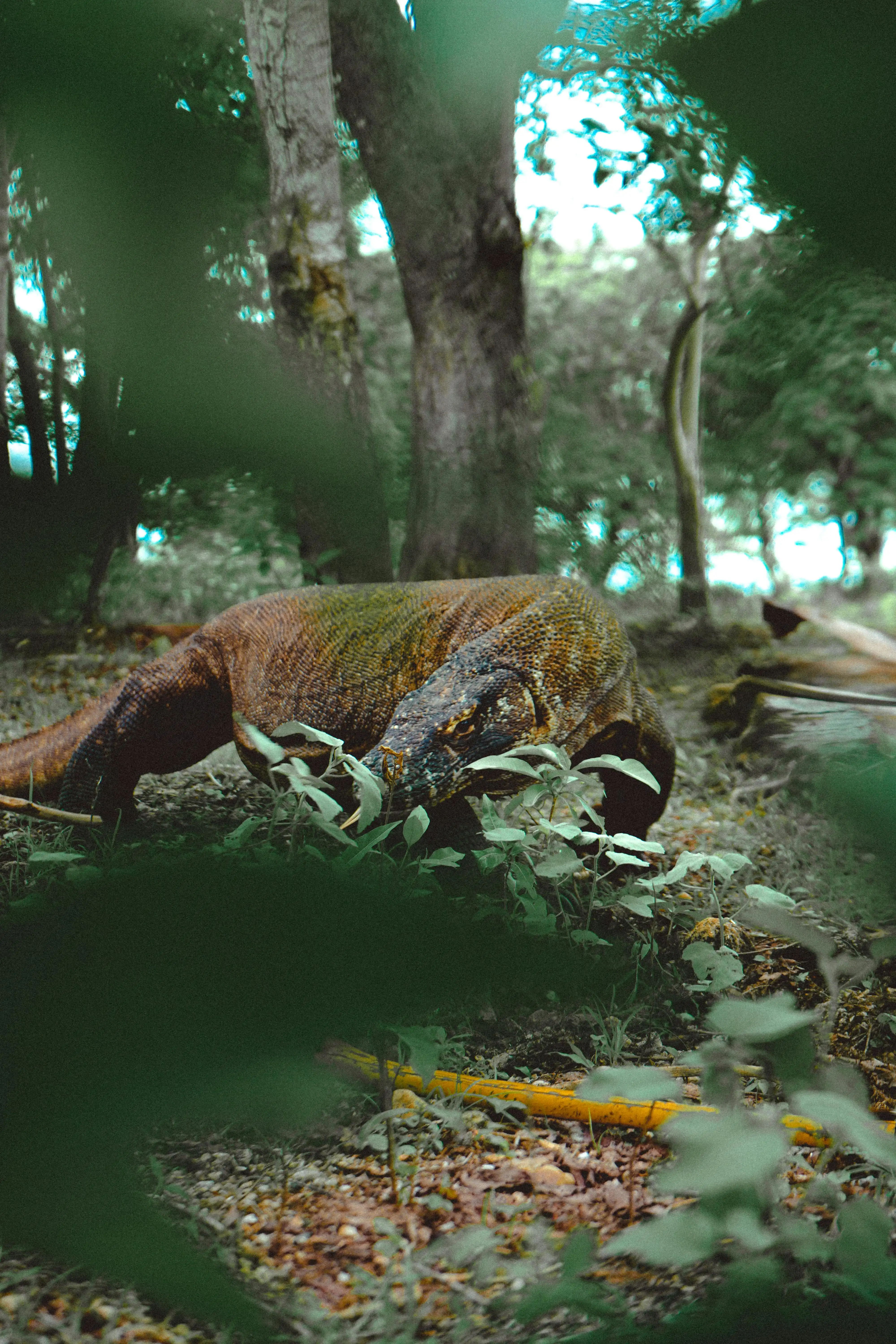
Varanus komodoensis — Rinca Island, Komodo National Park
Flores: The Island the Portuguese Named
The island itself has a name given by outsiders. When Portuguese sailors navigated these waters in the 16th century, they encountered a coastline dense with flowering trees and called it "Cabo das Flores," Cape of Flowers. The name shortened over time to Flores, and it stuck, carried forward through the Dutch colonial period that began in 1907, through Indonesian independence in 1945, and into the present.
Under Dutch administration, Labuan Bajo developed into a small trading port and missionary centre. It was never a colonial capital or a place of strategic importance to outside powers. It remained what it had always been: a working harbour at the edge of a large, difficult island, known to traders and fishermen but largely invisible to the wider world.
That changed in 2003, when Labuan Bajo was designated the administrative capital of the newly formed West Manggarai Regency. Then in 2011, Komodo National Park was recognised in a global public vote as one of the New Seven Wonders of Nature. The town that had spent centuries as a quiet anchorage suddenly found itself at the centre of something very large. In May 2023, Labuan Bajo hosted the 42nd ASEAN Summit, becoming a centre for international diplomacy and signalling to the world that this small harbour had arrived as a serious destination.
The old stilt-house settlements are still there if you look for them. So is the fish market before dawn, and the way the local fishermen read the sky before heading out. History here is not a museum exhibit. It is still in the water.
The Manggarai and the Living Culture of West Flores
The Manggarai people, who have farmed and governed the interior highlands of western Flores for centuries, bring a cultural richness to this region that most visitors only scratch the surface of.
The Formulamoso tradition governs the division of communal land using a finger formula adjusted to the amount of land and the number of descendants. Before land is divided, a Tente ceremony is held at the central lodok, and a village council meeting follows, presided over by the Tu'a Golo and authorised by the Tu'a Teno, the customary leader. It is a system of law that predates any written legal code in this part of Indonesia.
The Kepok tradition greets important guests with a red rooster and white moke, the local rice wine. At Loh Liang Pier, traditional elders dressed in songke cloth and destar headwear stand alongside women of West Manggarai to formally receive arrivals. It is genuine hospitality with centuries of practice behind it, not a performance.
The Manggarai are also known for their spider-web rice fields, the lingko, terraced in circular patterns that follow the contours of highland valleys, and for Wae Rebo, a traditional village high in the mountains above the Flores coast where drum-shaped houses have been continuously inhabited for generations. These places exist a world away from the harbour in character, but only a few hours by road.
On Land: What Flores and the National Park Actually Look Like
The landscape around Komodo National Park is unlike the tropical forest imagery most people carry in their heads when they think of Indonesia. The islands are dry, with open savannah grassland covering much of the hillside terrain. Long-grass slopes the colour of wheat in the dry season, broken by stands of palm and the occasional strangler fig. Padar Island, whose three-bay panorama has become the most photographed view in eastern Indonesia, looks more like a Scottish highland at certain angles than anything resembling a tropical postcard.
The vegetation shifts with the season and with altitude. Near the coast, mangrove systems shelter juvenile fish and provide nesting habitat for birds. Higher up, dragon orchids and rare ferns grow in the more sheltered gullies. Flores itself, particularly in its central volcanic highlands, carries the dense forest and crater lake scenery that gave the Portuguese their naming moment. Kelimutu, the volcano with three crater lakes that change colour independently of each other, sits in the island's interior and has no good explanation for why it does what it does.
There is no gradual build-up to it. You round a bend on the trail on Rinca Island, the ranger raises a hand, and there one is. Motionless on the path, head low, forked tongue tasting the air.
The Komodo Dragon
Varanus komodoensis is the largest living lizard on earth. Adults reach up to three metres in length and weigh up to 70 kilograms. They have been on these islands for millions of years. The IUCN reclassified them as Endangered in 2021, with a wild population estimated at fewer than 3,500 individuals. They exist nowhere else on the planet outside of five islands in eastern Indonesia: Komodo, Rinca, Flores, Gili Motang, and Gili Dasami.
They hunt using a combination of serrated teeth, powerful claws, and venom glands in their lower jaw that prevent blood from clotting in their prey. They can sprint at up to 20 kilometres per hour over short distances and are capable swimmers between islands. They are not aggressive toward humans who behave appropriately in their presence, but they are not domesticated and they are not indifferent. The ranger's forked walking staff is not a prop.
The experience of seeing one in its actual habitat — not in an enclosure, not with a fence between you, on a trail that it also uses — is something that recalibrates your understanding of what "wild" means. Most people do not say much for a while afterward.
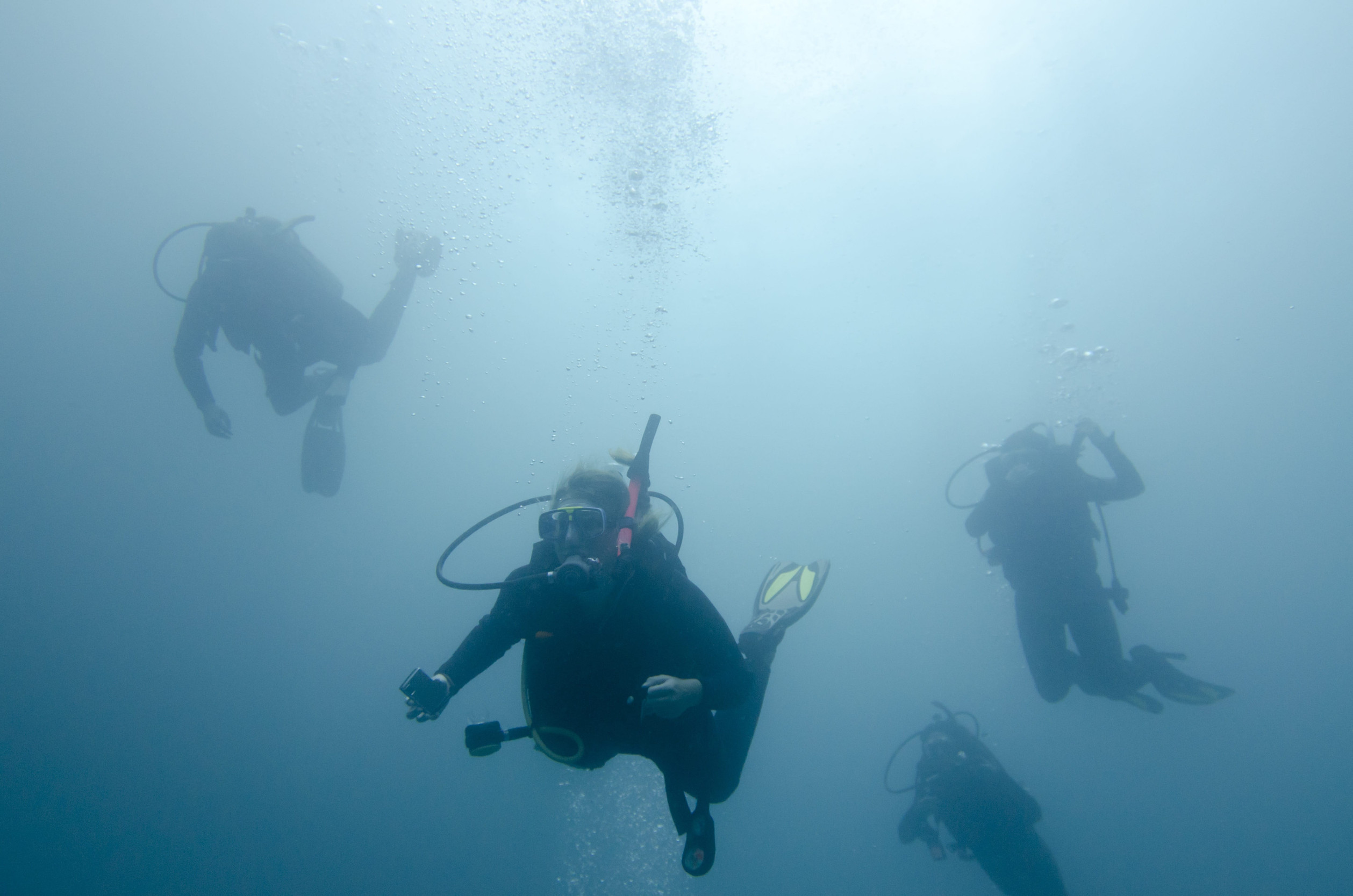
Dive site, Komodo National Park — over 1,000 recorded fish species
Under the Water
If the Komodo dragon is what draws people in, the sea is what makes them want to stay.
The marine protected area of Komodo National Park covers over 1,700 square kilometres of ocean. The convergence of warm and cold currents through the straits between islands creates conditions for extraordinary biodiversity. Over 1,000 species of fish have been recorded in these waters, along with more than 260 coral species, six species of marine turtle, and populations of oceanic manta rays that return to specific feeding sites with enough regularity that experienced guides can tell individual animals apart by their markings.
Manta Point, on the southern edge of the park near Komodo Island, is where the mantas come to be cleaned by smaller reef fish at specific sites along the seamount. At the right tidal moment, they glide in from the open ocean and hover almost motionless in the current while the reef fish do their work. Seeing one from the surface, wings spanning three metres or more, is a completely different experience from any photograph.
Pink Beach takes its name from the composition of its sand: white sand mixed with crushed fragments of red coral, producing a blush that deepens in the afternoon light. The reef immediately offshore is one of the healthier ones in the national park, with coral cover that includes table corals, brain corals, and colonies of soft coral in purples and oranges.
The currents that feed all of this biological richness are also the thing that demands respect from every person who enters the water here. They are strong, they shift with the tide, and they do not negotiate. Your operator and your guide will tell you exactly when and where it is safe to enter the water. That briefing is the most important part of any trip into the park.
At sunset, travel to Kalong Island. Every evening, thousands of flying foxes rise from the mangroves and form a massive cloud that crosses the strait toward Flores Island in search of food. It lasts about twenty minutes and it is the strangest, most quietly spectacular thing in a place that does not lack for competition.
Coming Here
Labuan Bajo is not a stopover. It is not a box to check on the way to somewhere more well-known. It is a place with a long and specific history, an ecology that took millions of years to produce, and a marine environment that exists at a level of biological complexity that scientists are still mapping.
The best way to experience it is slowly, on the water, with people who know it well.
That is what we do at Dara Flores Adventures. Small groups, traditional Phinisi boats, and itineraries built around what these waters and islands actually reward rather than what a checklist demands.
Explore Komodo with a local operator
Replies in under 2 hours · Bahasa & English · Open-trip and private charter
Prefer email? Join the journal list →